


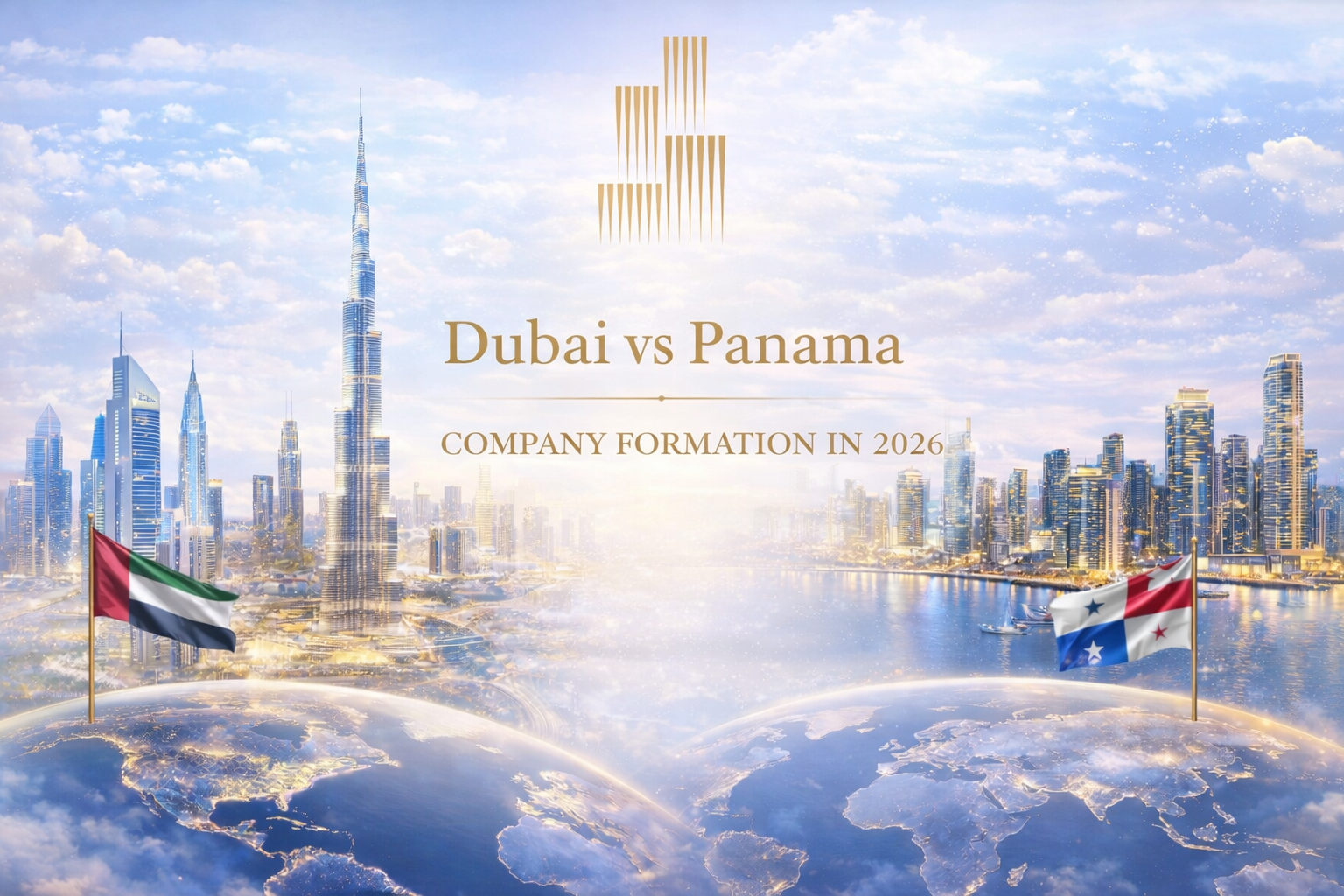
Tax Comparison, Banking Strategy and International Structuring Guide
Opening a company in Dubai UAE or registering a company in Panama in 2026 is no longer a simple offshore incorporation decision. It is a strategic choice involving corporate taxation, international compliance, banking approval probability, economic substance requirements, asset protection and long-term scalability.
Entrepreneurs, IT founders, e-commerce operators, consultants, commodity traders and high-net-worth individuals increasingly compare Dubai company formation vs Panama company registration to determine the most efficient jurisdiction for international business expansion.
This guide explains the tax differences, compliance implications, banking considerations and practical use cases of both jurisdictions.
Why Jurisdiction Selection Matters in 2026
Global transparency frameworks such as CRS reporting, FATF standards and OECD alignment have transformed international structuring.
Company formation today must consider:
• Banking compliance requirements
• Beneficial ownership disclosure
• Personal tax residency implications
• Cross-border reporting obligations
• Investor expectations
• Exit strategy planning
Selecting a jurisdiction based solely on headline tax rates can create banking or compliance obstacles later.
Dubai Company Formation in 2026
Corporate Tax, Compliance and Global Reputation
Dubai has positioned itself as a regulated international business hub aligned with global transparency standards and strong anti-money laundering enforcement.
Corporate Tax in Dubai
The UAE corporate tax system includes:
• 0 percent personal income tax
• 9 percent corporate tax on profits exceeding AED 375,000
• Potential 0 percent corporate tax for qualifying Free Zone income
• No withholding tax on dividends
• No capital gains tax in most operational scenarios
For businesses with genuine economic substance, Dubai offers a predictable and internationally accepted tax environment.
Free Zone vs Mainland Company Formation in Dubai
Free Zone Company Formation
Free Zone companies are commonly used for:
• IT services
• Consulting
• E-commerce
• Digital marketing
• Fintech
• International trading
• Holding structures
They allow 100 percent foreign ownership and may qualify for 0 percent corporate tax on certain income, subject to regulatory conditions.
Mainland Company Formation
Mainland companies are generally preferred when:
• Direct access to the UAE local market is required
• Government contracts are planned
• Broader activity scope is necessary
Dubai is not perceived as a secrecy-based offshore jurisdiction. Its regulatory transparency strengthens global counterparty trust and improves international banking acceptance.
Panama Company Registration
Territorial Taxation and Offshore Structuring
Panama operates under a territorial taxation system. Income generated outside Panama is generally not subject to Panamanian corporate tax.
Core Characteristics of Panama Company Formation
• Zero tax on foreign-sourced income
• Remote incorporation possible
• Relatively low incorporation cost
• Flexible corporate structuring
• Nominee director options permitted
Panama companies are frequently used for holding structures, intellectual property ownership, asset protection planning and passive investment vehicles.
However, international perception and banking scrutiny must be carefully assessed before selecting Panama as an operational base.
Tax Differences Between Dubai and Panama
Dubai applies a corporate tax regime with a defined threshold and structured compliance framework. Taxation is transparent, predictable and aligned with global reporting standards.
Panama applies territorial taxation, meaning foreign-sourced income is generally not taxed locally. However, practical tax outcomes depend heavily on the founder’s personal tax residency and reporting obligations in their home country.
The effective tax burden is determined not only by jurisdictional rules but also by substance, cross-border reporting and banking compliance.
Corporate Bank Account Opening in 2026
UAE vs Panama Banking Considerations
Opening a corporate bank account has become one of the most critical aspects of company formation.
Banks in the UAE and internationally typically require:
• Clear business model explanation
• Verified source of funds
• Client and supplier contracts
• Transparent beneficial ownership
• Tax residency clarification
• Demonstration of economic substance
Banking with a Dubai Company
Dubai companies with physical office presence, residence visas and proper accounting records generally present stronger compliance profiles. This improves approval probability and payment infrastructure stability.
Banking with a Panama Company
Panama structures without operational substance may face enhanced due diligence, especially when transaction flows involve EU or US counterparties. Offshore perception can influence compliance review intensity.
Banking feasibility should be analyzed before incorporation.
Residency and Personal Tax Implications
UAE Residency Through Company Formation
Dubai company formation can provide eligibility for:
• UAE residence visa
• Emirates ID
• Access to UAE banking as a resident
For entrepreneurs seeking relocation or personal tax residency planning, Dubai offers structural advantages.
Panama Residency Programs
Panama offers residency options as well. However, personal tax consequences must be evaluated in light of global reporting obligations and home-country tax rules.
Personal tax residency often determines whether territorial taxation provides real benefit.
Economic Substance and International Transparency
Modern international structuring must align with:
• CRS automatic exchange of information
• FATF anti-money laundering standards
• OECD reporting requirements
• Beneficial ownership disclosure obligations
Dubai has aligned its regulatory framework with international compliance expectations. This increases institutional trust and investor comfort.
Panama remains suitable for specific holding and asset protection scenarios but requires careful planning to ensure banking usability and reporting alignment.
When Dubai Company Formation Is Often Preferred
Dubai is frequently chosen by:
• IT companies serving EU or US clients
• Fintech and compliance-sensitive businesses
• International trading companies
• Entrepreneurs seeking UAE residence visa
• Businesses planning institutional investment
• Companies requiring reputable international banking
When Panama Company Registration Is Structurally Appropriate
Panama is often used for:
• International holding companies
• Intellectual property ownership
• Asset protection planning
• Passive investment vehicles
• Multi-layered dividend distribution structures
In certain cases, combining a Dubai operational company with a Panama holding entity may provide structural balance between credibility and tax flexibility.
Practical Structuring Insight
International company formation in 2026 requires alignment between:
• Corporate taxation
• Banking approval probability
• Economic substance requirements
• Personal tax residency
• Counterparty perception
• Long-term exit planning
Jurisdiction selection is no longer a simple incorporation decision. It is a structural strategy that must withstand compliance review, banking assessment and commercial scrutiny.
Experienced cross-border structuring specialists approach Dubai vs Panama analysis as architectural planning rather than a registration procedure.
Frequently Asked Questions
Is Dubai tax free in 2026?
Dubai maintains 0 percent personal income tax. Corporate tax is 9 percent on profits exceeding AED 375,000, with potential 0 percent rate for qualifying Free Zone income.
Is Panama still considered offshore?
Panama operates a territorial tax system. However, some international institutions may classify it as offshore depending on transaction patterns and counterparty jurisdictions.
Can a UAE company open a bank account remotely?
Physical presence and complete compliance documentation significantly increase approval probability.
Does Panama require economic substance?
While incorporation may require minimal local presence, modern banking institutions increasingly evaluate operational reality and transaction logic.
Which jurisdiction is better for international business expansion?
The answer depends on business model, client geography, banking requirements, personal tax residency and long-term scalability goals.
Conclusion: Strategic Jurisdiction Selection
Choosing between Dubai company formation and Panama company registration in 2026 is not about marketing slogans or nominal zero tax.
It is about credibility, compliance alignment, banking feasibility and sustainable international growth.
A well-designed corporate structure must balance taxation efficiency with regulatory transparency and long-term commercial viability.